monarchmedia100
By Jessica Kenley
COUDERSPORT, Pa. — For Lucinda Weakland, spring doesn’t just bring warmer weather — it marks the start of “kitten season,” a time when the already-strained network of volunteers working to control the local cat population is pushed to its limits.
“I’m just chasing my tail, not catching up,” Weakland said with a tired laugh. “It’s kitten season.”
Weakland is a key volunteer with the Potter County Animal Assistance Project (PCAAP), where she coordinates adoptions, fosters cats, and helps organize spay-and-neuter efforts across a wide swath of northern Pennsylvania. She also works at A Way Out, a domestic violence organization, a dual role that has revealed a powerful and often overlooked connection between animal welfare and human crisis.

A Growing Need — for Animals and People
Each spring, the number of stray and abandoned cats spikes dramatically. Weakland recently responded to multiple cases involving dozens of kittens born within weeks of each other.
“One woman thought she had all her cats fixed,” she said. “Turns out she had a male and a female — now there are three litters.”
For Weakland and the small team of roughly 10 to 12 volunteers, each new litter means more scrambling for foster homes, veterinary care, and eventual adoption placements. Without a physical shelter, the group relies entirely on community members willing to take animals into their homes.
“If we don’t have fosters, that’s their last best hope,” she said.
Trap, Neuter, Release — and Reality

A cornerstone of PCAAP’s work is trap-neuter-release (TNR), a method proven to stabilize and reduce feral cat populations. While some community members question why cats are returned outdoors, Weakland says the alternative is far worse. “We had a trailer park with 73 cats” she said that took us six months.”
“There is nowhere else for them to go,” she explained. “If we move them, they try to come back — and often don’t survive.”
Through partnerships with organizations like Spay Neuter Save Network (SNSN), PCAAP helps fix about 20 cats per month, transporting them to mobile clinics or facilities as far as Rome, PA–a two-hour trip. Each procedure costs about $100 — a figure Weakland often uses to illustrate the stakes.
“If you think that’s expensive, wait until they start having babies,” she said.
When Pets Keep People from Leaving

Weakland’s work with A Way Out has shown her another side of the issue: people in crisis who refuse to leave dangerous situations because they cannot bring their pets.
Through partnerships with groups like Teacher’s Pet and national organizations such as Red Rover, arrangements can be made to foster animals temporarily while individuals seek safety.
“It’s becoming more and more important,” Weakland said. “People won’t leave [bad situations] if they think their pet will be harmed.”
The issue overlaps with broader challenges in rural communities, including a lack of affordable housing. Weakland noted that some residents experiencing homelessness choose to remain outdoors rather than abandon their animals.
Community Support — and Creative Fundraising
Despite limited resources, PCAAP has found success through grassroots fundraising and community involvement. One standout initiative is the “Cutest Cat Contest,” created by volunteer Darlene Forsythe. Residents vote for their favorite feline by placing donations into labeled jars — turning spare change into lifesaving funds. The Cutest Cat Contest is now at the bank in Genesee, for anyone who is interested in participating.
Other efforts include donation jars at local businesses, the Riley Gallery, raffles, and online giving through platforms like Zeffy, which allows nonprofits to receive full donations without processing fees.
Even small contributions add up. “Fifty dollars from collecting cans — that’s half a cat,” Weakland said.
The group also maintains a “wish list” of needed supplies and regularly receives donations of food, formula, and other essentials from supportive residents. Here is the link to the wish list: chewy.com/g/potter-county-animal-assistance-project-pcaap_b108329864#wish-list
The Human Side of Rescue
For Weakland, the emotional rewards of the work often come from the connections formed between animals and their adopters.
She recalls a formerly abused cat named Bennie Bear, rescued with visible injuries and deep fear, who eventually found a safe, loving home. “Somebody had taken a cigarette or something, and burned a cross on his face,” she said.

Another case involved a cat named Groot, whose calm temperament helped a young child with autism open up and engage. “[The boy’s mother] sent me a picture two days later, he had a little Mr. Potato Head, and Groot’s wearing the hat, and they’re buddies. He would pop his matchbox cars underneath a piece of furniture, and Groot would be under there and kick it back. And you could see the change in that child. He had somebody to play with that understood him. And that’s the kind of thing that makes fostering worthwhile.”
Weakland went on, “I’ve seen female gang members in a prison, you know, and these are tough, tough people. And they learn to care for something besides themselves. They learn to heal by healing animals…It’s really neat to watch somebody change, to watch how their face untenses…it’s just an awesome experience. It changes them.”
How to Help
As kitten season intensifies, Weakland says the need for help is urgent — but accessible.
Residents can foster even one cat, donate supplies, or support spay-and-neuter efforts financially. Weakland explained, “Even if people take one cat because we don’t have a shelter…if there’s any message I can get out to people, we have so many abandoned cats–they’re not all feral. Every colony started can be traced back to somebody who put out a pet that was not fixed, right?”
Weakland noted that the community support has been “wonderful.” She has some volunteer “colony keepers” – people who will feed the cat colonies–PCAAP pays for the food– and provides small, insulated shelters for them. She said there are Youtube videos on how to make old coolers into cat shelters.
Here is one: https://www.youtube.com/watch?v=ht7efNutAi4
In the winter, this really matters–“If they can get in, out of the wind and cold and dig down into straw, they can be safe. So I mean, that’s the best we can do for the colonies.”
Another thing people can do is make covers for the humane cat traps using old sheets. “It’s recycling, it’s a good thing,” she said.
An important myth that Weakland wants to dispel is that a housecat can be dumped at a farm and be okay: ”Farm cats are a colony. The cats are going to get beat up or eaten by wildlife, period. Full stop. You’ve put them on another planet. Do not dump your cats at farms. They do not want them, and they’re not going to be welcomed there. You might as well put a sticky note on them and call them lunch…I have had cats die from the trauma.”
Another fundraiser PCAAP is doing is through Linda Rohrer, an artist who does paintings and then donates a portion of her proceeds. Remembering a few years back, Weakland reminisced, “There was a Girl Scout troop of second and third-graders who collected food, and they had collars, and toys, they did a wonderful job…Once a girl handed me a bag of pennies–like a grocery bag–and it was about $35 worth–that bought our first banner!”
Above all, Weakland stresses one message: prevention matters.
For a small volunteer group covering a large rural county, the work can feel overwhelming. But Weakland remains determined. “My vehicle is officially the cat-mobile,” she said, laughing. “I think the problem is getting better–we just need people. We’d really like to start doing stuff in schools.”
Weakland concluded the interview with: “I’m not giving up. We just keep going — one cat at a time.”
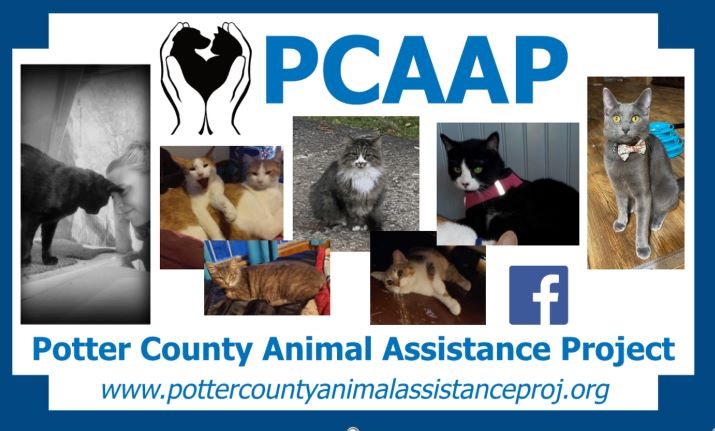
To help out, go to:
Or go to their Facebook page at: https://www.facebook.com/pcaap
This is the link to PCAAP’s Chewy wishlist: chewy.com/g/potter-county-animal-assistance-project-pcaap_b108329864#wish-list
You can contact PCAAP by calling: 814-389-5599
Or email them at: pcaap2012@gmail.com